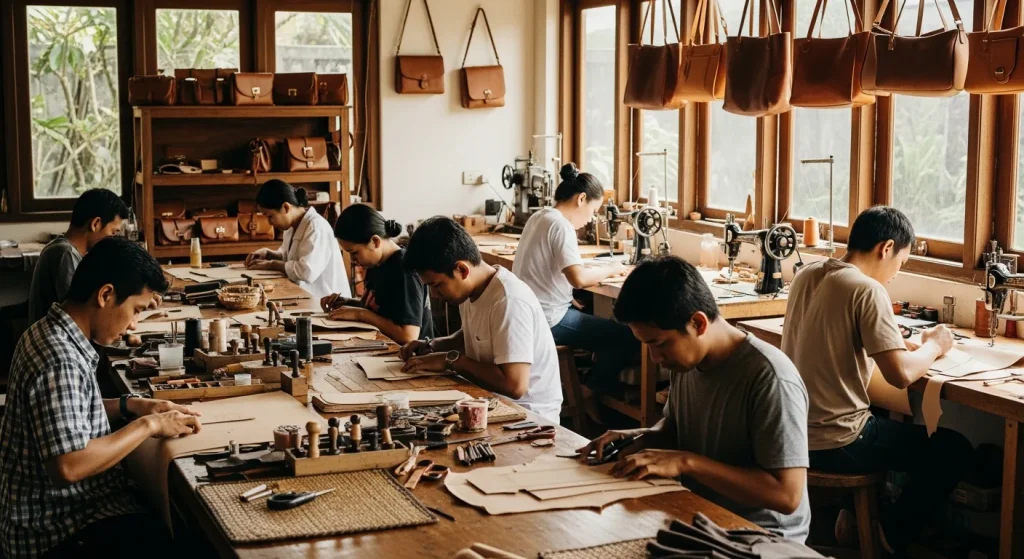
The Bali leather bags wholesale segment operates within a robust Asia-Pacific leather goods market, projected to grow at a 5-7% CAGR through 2033–2035. Bali serves as a specialised production and sourcing hub for tourism, small brands, and online retailers, benefiting from increasing global consumption and strong regional growth in leather products.
Bali Leather Bags Wholesale 2027: How to Avoid Common Sourcing Mistakes and Ensure Quality Control
For importers, wholesalers, retailers, interior contractors, and trade buyers, sourcing wholesale handmade leather bags from Indonesia, specifically Bali, presents both opportunities and challenges. While the market for leather goods and handbags shows consistent growth, sourcing landscape requires a disciplined approach to avoid common pitfalls and maintain quality.
Market Context for Bali Leather Bags Wholesale (2026–2027)
While specific figures for "Bali leather bags wholesale" are not discretely published, the sector is intrinsically linked to broader market trends. The global leather bags market was valued at USD 73.12 billion in 2024, expecting to reach USD 76.77 billion in 2025 and USD 113.45 billion by 2033, demonstrating approximately a 5% CAGR (2025–2033). Similarly, the global leather goods market, valued at USD 531.07 billion in 2025, is projected to reach USD 982.42 billion by 2034, growing at a 7.13% CAGR (2026–2034). The global handbag market also shows strong performance, with an estimated size of USD 86.88 billion in 2025, forecast to reach USD 146.02 billion in 2033 at a 6.8% CAGR (2026–2033). The Asia-Pacific region accounts for approximately 38.5% of global handbag revenue in 2025 and is expected to grow at a 7.8% CAGR (2026–2033).
Asia-Pacific leather goods revenue was USD 117.8 billion in 2025, projected to USD 126.64 billion in 2026. Indonesia, as a manufacturing and tourism hub, contributes to this regional growth alongside other significant players like China, Vietnam, and India. The practical implication for Bali’s wholesale sector in 2026–2027 is sustained demand driven by rising global consumption and robust Asia-Pacific growth, particularly in travel-driven retail environments like Bali. Bali’s wholesale leather bag sector remains niche but shows growth, supported by small and medium global brands sourcing from artisan workshops, export orders via online channels, and tourist-driven bulk purchases by small resellers.
2027 Note on Sourcing
For 2027, buyers should anticipate continued emphasis on verifiable ethical sourcing and sustainability claims from Bali manufacturers. Due diligence will increasingly involve requesting documentation on material origins, labour practices, and waste management. Manufacturers who can transparently provide this information will be preferred partners, aligning with evolving consumer and regulatory expectations in key import markets.
Common Sourcing Mistakes and How to Avoid Them
Sourcing wholesale handmade leather bags from Bali requires careful planning. Avoiding common mistakes is crucial for a successful partnership and product delivery.
1. Lack of Clear Specifications
Mistake: Providing vague or incomplete product specifications. This often leads to misinterpretations, production delays, and products that do not meet expectations.
Avoidance: Develop comprehensive product specification sheets. These should include detailed measurements, material types (e.g., specific leather grade, lining fabric), hardware finishes, stitching details, colour codes (Pantone references), and any specific construction methods. Provide technical drawings or clear photographs with annotations. For handmade items, acknowledge and discuss acceptable variations with your supplier upfront.
2. Inadequate Supplier Vetting
Mistake: Selecting suppliers based solely on price or initial impressions without thorough due diligence. This can result in unreliable quality, missed deadlines, and poor communication.
Avoidance: Implement a rigorous supplier vetting process. This involves checking references, requesting samples of previous work, and ideally, conducting factory visits or third-party audits. Assess their production capacity, quality control procedures, and communication effectiveness. For Bali Leather Bags Wholesale, we encourage requests for our production portfolio and process documentation.
3. Skipping Prototype and Sample Approvals
Mistake: Proceeding with bulk production without approving a physical prototype or pre-production sample. Digital mock-ups are insufficient for handmade leather goods.
Avoidance: Always request and physically inspect a prototype. This allows for identifying design flaws, material discrepancies, and construction issues before mass production. Once the prototype is approved, a pre-production sample should be made using the exact materials and processes intended for the bulk order. Only after this sample is approved in writing should full production commence.
4. Neglecting Payment Terms and Contracts
Mistake: Operating without clear, legally binding contracts and payment schedules. This can lead to disputes over payments, production timelines, and order cancellations.
Avoidance: Establish clear contracts that detail product specifications, pricing, payment terms (e.g., deposit, progress payments, final payment upon inspection), delivery schedules, quality control standards, and dispute resolution mechanisms. Understand local Indonesian business practices and ensure contracts are legally sound in both jurisdictions where applicable.
5. Poor Communication
Mistake: Irregular or unclear communication with the supplier, particularly across different time zones and languages.
Avoidance: Maintain consistent, clear, and documented communication. Appoint a primary contact person on both sides. Utilise communication tools that allow for written records (email, WhatsApp Business). Be explicit in requests and feedback. Anticipate potential communication barriers and work to bridge them.
Ensuring Quality Control for Bali Leather Bags
Quality control is paramount for wholesale handmade leather bags. Implementing robust checks throughout the production cycle mitigates risks and ensures product consistency.
1. Material Sourcing and Inspection
The quality of the final product begins with the raw materials.
- Leather: Specify the type of leather (e.g., cowhide, goatskin), tanning process (e.g., vegetable-tanned, chrome-tanned), thickness, and finish. Inspect incoming leather for consistent colour, texture, and absence of major defects (scars, branding marks, excessive stretching).
- Hardware: Define the material (e.g., brass, zinc alloy), finish (e.g., antique brass, nickel), and weight/durability of all buckles, zippers, rivets, and clasps. Test samples for functionality and resistance to tarnishing or breakage.
- Linings and Adhesives: Specify fabric type, weight, and colour for linings. Ensure adhesives are appropriate for leather and durable under various conditions.
2. In-Process Quality Checks
Quality control should be integrated at various stages of production, not just at the end.
- Cutting: Verify that leather pieces are cut accurately according to patterns, with clean edges and minimal waste.
- Stitching: Inspect stitching for consistency in length, tension, and alignment. Ensure all seams are strong, straight, and free from loose threads or skipped stitches.
- Assembly: Check that components are assembled correctly, hardware is securely attached, and any internal pockets or compartments are positioned accurately.
- Finishing: Review edges for proper burnishing or painting, ensuring a smooth and durable finish. Inspect for any glue residue, scratches, or blemishes on the leather surface.
3. Final Inspection and Packaging
A comprehensive final inspection is critical before shipment.
| Inspection Point | Details | Tolerance/Standard |
|---|---|---|
| Overall Appearance | Check for design adherence, symmetry, and aesthetic appeal. | Must match approved sample; no visible defects. |
| Functionality | Test zippers, clasps, straps, and buckles for smooth operation and security. | All functional elements must operate correctly. |
| Dimensions | Measure key dimensions (length, width, depth, strap drop). | Within +/- 1-2 cm of specified dimensions. |
| Stitching Quality | Examine all seams for consistency, strength, and neatness. | No loose threads, skipped stitches, or broken seams. |
| Material Integrity | Inspect leather for scratches, discolouration, or imperfections. Hardware for tarnishing, damage. | No significant material defects; minor, natural leather variations acceptable. |
| Cleanliness | Ensure products are free from dust, glue residue, or foreign matter. | Clean and ready for retail display. |
| Packaging | Verify correct individual packaging (dust bags, poly bags) and carton packing. | Secure and protective to prevent transit damage. |
Ensure packaging is appropriate for international shipping, protecting items from moisture, impact, and abrasion. Clearly label cartons with product details, quantities, and handling instructions.
Partnering with Bali Leather Bags Wholesale
Working with a reputable B2B export house like Bali Leather Bags Wholesale simplifies the sourcing process. We manage supplier relationships, implement strict quality control protocols, and handle logistics, providing a streamlined experience for international buyers. Our expertise in the local production landscape and understanding of international trade requirements reduce risks and ensure consistent quality for your wholesale handmade leather bag orders.
For further information on our product range and sourcing capabilities, request a wholesale quote on WhatsApp.