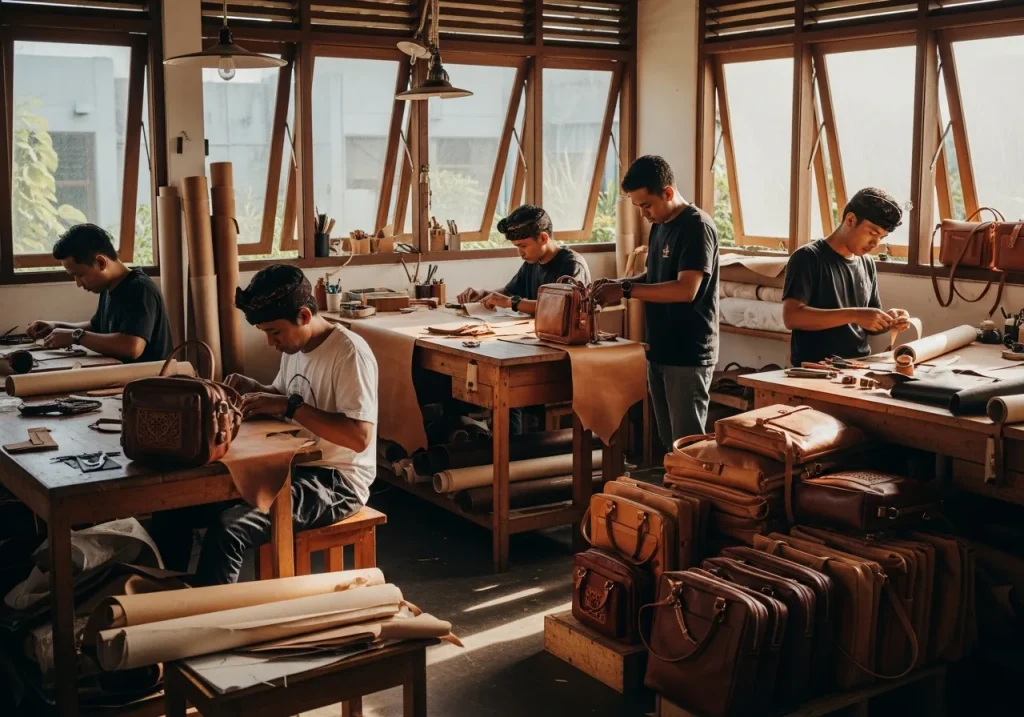
The Bali leather bags wholesale segment is part of a growing Asia-Pacific leather goods market, with global leather bags forecast to grow at approximately 5–7% CAGR through 2033–2035. Bali serves as a niche production and sourcing hub for tourism, small brands, and online retailers, experiencing growth supported by rising global consumption and strong regional demand.
Bali Leather Bags Wholesale 2027: How to Balance Customization, Cost, and Lead Time for Maximum ROI
For importers, wholesalers, retailers, and interior contractors seeking where to buy wholesale leather bags in Bali, understanding the balance between customization, cost, and lead time is critical for maximising return on investment. The global leather bags market, valued at USD 73.12 billion in 2024, is projected to reach USD 113.45 billion by 2033, growing at a ~5% CAGR (2025–2033). The broader global leather goods market, valued at USD 531.07 billion in 2025, is expected to reach USD 982.42 billion by 2034, with a 7.13% CAGR (2026–2034). The global handbag market also shows robust growth, from USD 86.88 billion in 2025 to USD 146.02 billion in 2033, at a 6.8% CAGR (2026–2033). Asia-Pacific accounts for 38.5% of global handbag revenue in 2025 and is forecast to grow at a 7.8% CAGR (2026–2033).
Bali’s leather bags wholesale sector operates within this expanding market, serving as a niche but growing hub. Demand is sustained by increasing global consumption of leather goods and handbags, coupled with strong Asia-Pacific growth and travel-driven retail in destinations like Bali. This sector is driven by small and medium global brands sourcing from artisan workshops, export orders placed via online channels, and tourist-driven bulk purchases by small resellers. The typical order values for Bali-sourced leather bags range from USD 500 to USD 5,000 for small resellers and online retailers, and USD 5,000 to USD 20,000 for larger wholesale orders, with some reaching USD 50,000+ for recurring trade buyers. These figures indicate a viable market for strategic sourcing.
Understanding Market Dynamics and Sourcing Channels
Bali’s leather bags wholesale market is characterised by its artisan-led production and diverse sourcing channels. The primary types of leather used include cowhide, goatskin, and sheepskin, with various finishes such as full-grain, top-grain, corrected-grain, and suede. Production methods range from entirely handmade to semi-machine-made, often incorporating traditional Balinese craftsmanship. This blend allows for a wide array of product styles, from casual and bohemian to more structured and contemporary designs.
Sourcing Channels for Bali Leather Bags Wholesale
- Direct from Workshops: Many small to medium-sized workshops in areas like Denpasar, Gianyar, and Tabanan offer direct wholesale. This channel provides opportunities for direct communication regarding customization but requires due diligence for quality control and order management.
- Export Houses and Agents: Established export houses, such as Bali Leather Bags Wholesale, act as intermediaries, consolidating orders, managing quality, and handling logistics. They often have long-standing relationships with multiple workshops, offering a broader product range and streamlined processes.
- Online Platforms: B2B marketplaces and direct websites of Balinese manufacturers facilitate orders, particularly for smaller quantities or initial samples.
- Trade Fairs: While less frequent for dedicated leather bags, general handicraft and furniture fairs in Indonesia occasionally feature leather goods suppliers, offering direct engagement opportunities.
The Customization Spectrum: From ODM to OEM
Customization is a significant draw for buyers sourcing from Bali. The flexibility offered by local workshops allows for various levels of product development, impacting both cost and lead time.
Original Design Manufacturing (ODM)
ODM involves selecting existing designs from a supplier’s catalogue and making minor modifications, such as changing colours, materials, or adding branding elements (e.g., logos, hardware). This approach offers:
- Lower Development Costs: No need for extensive pattern making or design conceptualisation.
- Faster Lead Times: Production can commence quickly as designs are pre-existing.
- Lower Minimum Order Quantities (MOQs): Suppliers are more amenable to smaller batches for established designs.
ODM is suitable for buyers seeking to quickly introduce new products with a unique touch, or for those with limited design resources.
Original Equipment Manufacturing (OEM)
OEM involves developing entirely new products based on the buyer’s specifications, including unique designs, materials, hardware, and construction. This approach provides:
- Unique Product Differentiation: Exclusive designs reduce market saturation and enhance brand identity.
- Higher Development Costs: Requires investment in pattern making, prototyping, and material sourcing.
- Longer Lead Times: Design, sampling, and approval processes extend the production cycle.
- Higher MOQs: Suppliers typically require larger orders to justify the investment in new product development.
OEM is ideal for brands aiming for exclusive product lines and a strong competitive edge, willing to invest time and resources into bespoke development.
Cost Implications in Bali Leather Bags Wholesale
The cost of wholesale leather bags from Bali is influenced by several factors:
- Material Quality and Type: Full-grain leather is more expensive than corrected-grain. Exotic leathers (e.g., python, crocodile, though less common for wholesale) command premium prices.
- Craftsmanship and Construction: Intricate designs, hand-stitching, and complex internal structures increase labour costs.
- Hardware Quality: Brass, stainless steel, or custom-designed hardware can significantly impact the final price compared to standard options.
- Order Volume: MOQs for Bali leather bags typically range from 12 to 50 pieces per design, though some small workshops may accept 6 pieces. Larger orders (100+ pieces) usually attract lower per-unit costs.
- Customization Level: OEM projects incur higher initial costs due to design and sampling, while ODM offers more predictable pricing.
- Logistics and Shipping: Freight costs, import duties, and insurance contribute to the landed cost. Buyers should account for these when evaluating total cost of ownership.
2027 note: By 2027, increasing raw material costs globally and potentially stricter environmental regulations in Indonesia may lead to a slight upward pressure on leather bag prices. Buyers should factor in a potential 3-5% increase in material costs when planning their budgets for the upcoming year, alongside a focus on suppliers with established ethical sourcing practices to mitigate supply chain risks.
Managing Lead Times for Optimal Inventory
Lead time management is crucial for maintaining inventory levels and meeting market demand. For Bali leather bags wholesale, lead times vary based on complexity and order size.
Typical Lead Time Breakdown
| Stage | Approximate Duration | Notes |
|---|---|---|
| Sample Development (OEM) | 2-4 weeks | Dependent on design complexity and revisions. |
| Material Sourcing | 1-2 weeks | For standard leathers; custom colours/finishes may take longer. |
| Production (ODM) | 4-8 weeks | For orders of 50-200 pieces; varies with workshop capacity. |
| Production (OEM) | 6-12 weeks | Longer due to new design production processes. |
| Quality Control & Packaging | 1 week | Essential for ensuring product standards. |
| Shipping (Sea Freight) | 3-6 weeks | To major international ports; varies by destination. |
| Shipping (Air Freight) | 3-7 days | Faster but significantly more expensive. |
Total lead times, from order confirmation to delivery, can range from 8 weeks for simple ODM orders shipped via air freight, to 20+ weeks for complex OEM projects shipped via sea freight. Effective communication with suppliers and clear production schedules are vital for managing expectations.
Maximising ROI Through Strategic Sourcing
To maximise ROI when sourcing wholesale leather bags from Bali, buyers should adopt a strategic approach that balances the three key factors:
- Define Customization Needs: Clearly determine whether ODM or OEM is required. For initial market testing or quick product launches, ODM offers a faster, lower-cost entry. For building a distinct brand identity, OEM justifies the investment.
- Negotiate Costs Transparently: Understand the cost drivers (materials, labour, hardware) and negotiate based on order volume and long-term partnership potential. Consider value engineering by exploring alternative materials or construction methods without compromising quality.
- Plan Lead Times Realistically: Factor in ample time for sampling, production, and shipping. For time-sensitive collections, consider air freight despite higher costs. For regular stock replenishment, sea freight is more economical. Establish clear production milestones and regular communication with the supplier.
Working with an established export house like Bali Leather Bags Wholesale can streamline this process. They offer expertise in navigating local production nuances, managing quality control, and coordinating logistics, providing a single point of contact for complex orders. This reduces risk and allows buyers to focus on their market strategy.
By carefully considering customization levels, understanding cost implications, and planning for realistic lead times, trade buyers can effectively leverage Bali’s artisan capabilities to achieve strong returns on their wholesale leather bag investments. For further inquiries or to discuss your specific sourcing requirements, you can request a wholesale quote on WhatsApp.