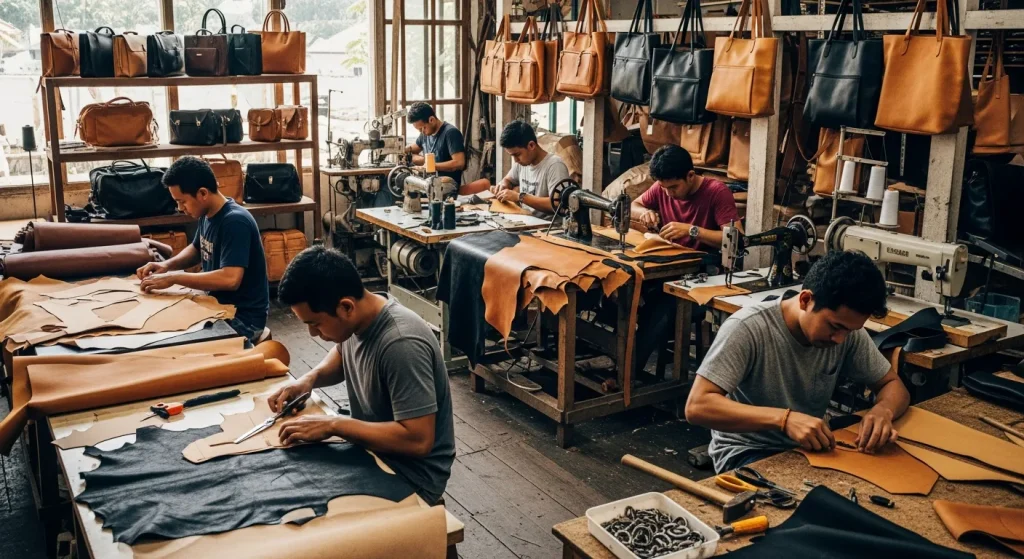
The Bali leather bags wholesale segment operates within a global leather goods market valued at USD 531.07 billion in 2025, with leather bags alone at USD 73.12 billion in 2024. This market is projected to grow at approximately 5–7% CAGR through 2033–2035, driven by Asia-Pacific growth and tourism.
Bali Leather Bags Wholesale 2027: How to Scale Your Order from 5 to 500+ Pieces Without Quality Loss
For importers, wholesalers, retailers, and interior contractors, scaling orders from small batches to significant volumes presents a common challenge, particularly when maintaining consistent quality. In the context of Bali leather bags wholesale, understanding the market dynamics and implementing structured processes are crucial for successful expansion. This article outlines how to achieve substantial order scaling without compromising the export quality synonymous with Bali’s craft.
1. Market Size & Growth: Understanding the Landscape
While specific figures for “Bali leather bags wholesale” are not published independently, the sector is part of a larger, growing market. The global leather bags market was valued at USD 73.12 billion in 2024, projected to reach USD 113.45 billion by 2033, demonstrating a compound annual growth rate (CAGR) of approximately 5% from 2025 to 2033. The broader global leather goods market, valued at USD 531.07 billion in 2025, is forecast to reach USD 982.42 billion by 2034, with a 7.13% CAGR from 2026 to 2034. The global handbag market also shows robust growth, from USD 86.88 billion in 2025 to USD 146.02 billion in 2033, at a 6.8% CAGR.
Asia-Pacific is a significant driver, holding 38.5% of global handbag revenue in 2025 and projected to grow at a 7.8% CAGR from 2026 to 2033. Asia-Pacific leather goods revenue was USD 117.8 billion in 2025, expected to reach USD 126.64 billion in 2026. Indonesia, as a manufacturing and tourism hub, participates in this regional growth. Bali’s wholesale leather bag sector is niche but growing, supported by small and medium global brands, online export orders, and tourist-driven bulk purchases.
Demand for Bali leather bags is supported by rising global consumption of leather goods and handbags, coupled with strong Asia-Pacific growth and travel-driven retail. The island’s appeal lies in its artisan workshops, offering bespoke and handcrafted items.
2. The Scaling Challenge: From Artisan to Industrial Volumes
Scaling production from 5 to 500+ pieces introduces complexities beyond simple multiplication. Initial small orders often involve direct artisan involvement, allowing for detailed oversight. Larger orders necessitate more structured production, standardised processes, and robust quality control mechanisms. The primary challenge is replicating the initial quality and consistency across a significantly larger batch, often involving multiple production teams or workshops.
2027 Note:
By 2027, the emphasis on supply chain transparency and ethical sourcing will be more pronounced. Buyers will increasingly require verifiable information on material origin, labour practices, and environmental impact. Suppliers in Bali must be prepared to provide this documentation to meet evolving international trade standards and buyer expectations.
3. Supplier Selection and Partnership Development
Selecting the right manufacturing partner is foundational to scaling. A capable supplier for export quality leather bags in Bali will possess several key attributes:
- Proven Production Capacity: The ability to handle current and projected order volumes without compromising lead times. This includes access to skilled labour and appropriate machinery.
- Robust Quality Control Systems: Established protocols for material inspection, in-process checks, and final product evaluation. This ensures consistency across batches.
- Experience with Export: Familiarity with international shipping, documentation, and compliance requirements.
- Communication and Transparency: Open dialogue regarding production progress, potential issues, and timelines.
- Financial Stability: A secure financial footing to manage material procurement for large orders.
Developing a long-term partnership with a supplier involves clear communication of expectations, regular feedback, and a collaborative approach to problem-solving. This relationship extends beyond transactional exchanges to a strategic alliance focused on mutual growth.
4. Standardisation of Materials and Processes
Maintaining quality across large orders requires standardisation. This begins with material specifications. Define precise leather types, thicknesses, finishes, and hardware. Provide samples and detailed specifications to ensure all materials meet the required standards. For leather, specify hide origin, tanning process, and any treatments. For hardware, specify metal composition, plating, and durability standards.
Production processes must also be standardised. Develop clear manufacturing guidelines, including cutting patterns, stitching techniques, assembly instructions, and finishing protocols. Utilise technical packs (tech packs) that detail every aspect of the product, from dimensions and materials to stitching per inch and logo placement. This reduces ambiguity and ensures uniformity, irrespective of who performs the task.
5. Implementing Multi-Stage Quality Control
A comprehensive quality control (QC) system is essential for large-scale production. This involves checks at various stages:
- Raw Material Inspection: Verify incoming leather and hardware against specifications before production begins. Reject non-conforming materials.
- In-Process Quality Checks: Regular inspections during cutting, stitching, and assembly. This catches defects early, preventing wasted materials and rework.
- Mid-Production Audit: A thorough check of a percentage of items once a significant portion of the order is completed. This identifies systemic issues.
- Pre-Shipment Inspection (PSI): A final, comprehensive inspection of finished goods before packaging and shipment. This typically involves AQL (Acceptable Quality Limit) sampling to determine overall batch quality.
For export quality leather bags from Bali, these QC stages are critical. Consider engaging independent third-party inspection services for larger orders to provide an unbiased quality assessment.
6. Production Management and Communication
Effective production management is key to scaling. This includes:
- Detailed Production Planning: Breaking down the order into manageable stages with assigned timelines and responsibilities.
- Capacity Planning: Ensuring the supplier has sufficient capacity (labour, machinery, space) to meet the order volume within the agreed timeframe.
- Regular Progress Monitoring: Daily or weekly updates on production status, identifying potential delays or bottlenecks promptly.
- Contingency Planning: Having backup plans for material shortages, labour issues, or machinery breakdowns.
Clear communication channels with the supplier are paramount. Establish regular check-in calls or meetings, and maintain written records of all decisions and agreements. This ensures everyone is aligned and can respond quickly to any issues.
7. Packaging and Logistics for Scale
For large orders, packaging and logistics become more complex. Packaging must protect items during transit, especially for international shipping. Specify inner packaging (e.g., dust bags, tissue paper) and outer packaging (e.g., cartons, pallets) that meet export standards. Labelling must be accurate for customs and inventory management.
Logistics planning includes:
- Shipping Method: Air freight for speed, sea freight for cost-effectiveness on large volumes.
- Incoterms: Clearly define responsibilities and costs between buyer and seller (e.g., FOB, CIF).
- Customs Documentation: Ensure all necessary permits, certificates of origin, and invoices are prepared accurately to avoid delays.
Working with experienced freight forwarders who understand Indonesian export procedures is advisable for large volumes.
8. Cost Management and Pricing Strategy
Scaling orders often allows for economies of scale, potentially reducing per-unit costs. Negotiate bulk pricing for materials and production. However, be aware of potential cost increases related to:
- Increased QC Efforts: More rigorous inspections may add to labour costs.
- Logistics: Larger shipments require more complex handling.
- Inventory Management: Holding larger quantities of raw materials or finished goods.
A transparent cost breakdown from the supplier is beneficial. This allows for informed pricing strategies for your own market, ensuring profitability while remaining competitive.
| Aspect | Small Order (5 Pieces) | Large Order (500+ Pieces) |
|---|---|---|
| Production Method | Artisan-led, manual | Standardised processes, potentially mechanised elements |
| Quality Control | Direct oversight by artisan/buyer | Multi-stage QC system, AQL sampling |
| Material Sourcing | Local, small batch | Bulk procurement, specific vendor contracts |
| Packaging | Basic protective wrapping | Export-grade cartons, pallets, protective inserts |
| Logistics | Courier/post | Freight forwarder (sea/air), customs clearance |
| Documentation | Basic invoice | Commercial invoice, packing list, B/L, Certificate of Origin |
| Supplier Relationship | Informal, direct | Formal, contract-based partnership |
Scaling orders for export quality leather bags from Bali is achievable through careful planning, robust supplier partnerships, and stringent quality control. By focusing on standardisation, multi-stage inspections, and effective communication, importers and wholesalers can confidently expand their sourcing from Bali without compromising the craft and quality their customers expect. This strategic approach ensures long-term success in a growing global market.
For detailed discussions on your specific sourcing requirements or to understand how Bali Leather Bags Wholesale can support your volume expansion, request a wholesale quote on WhatsApp.